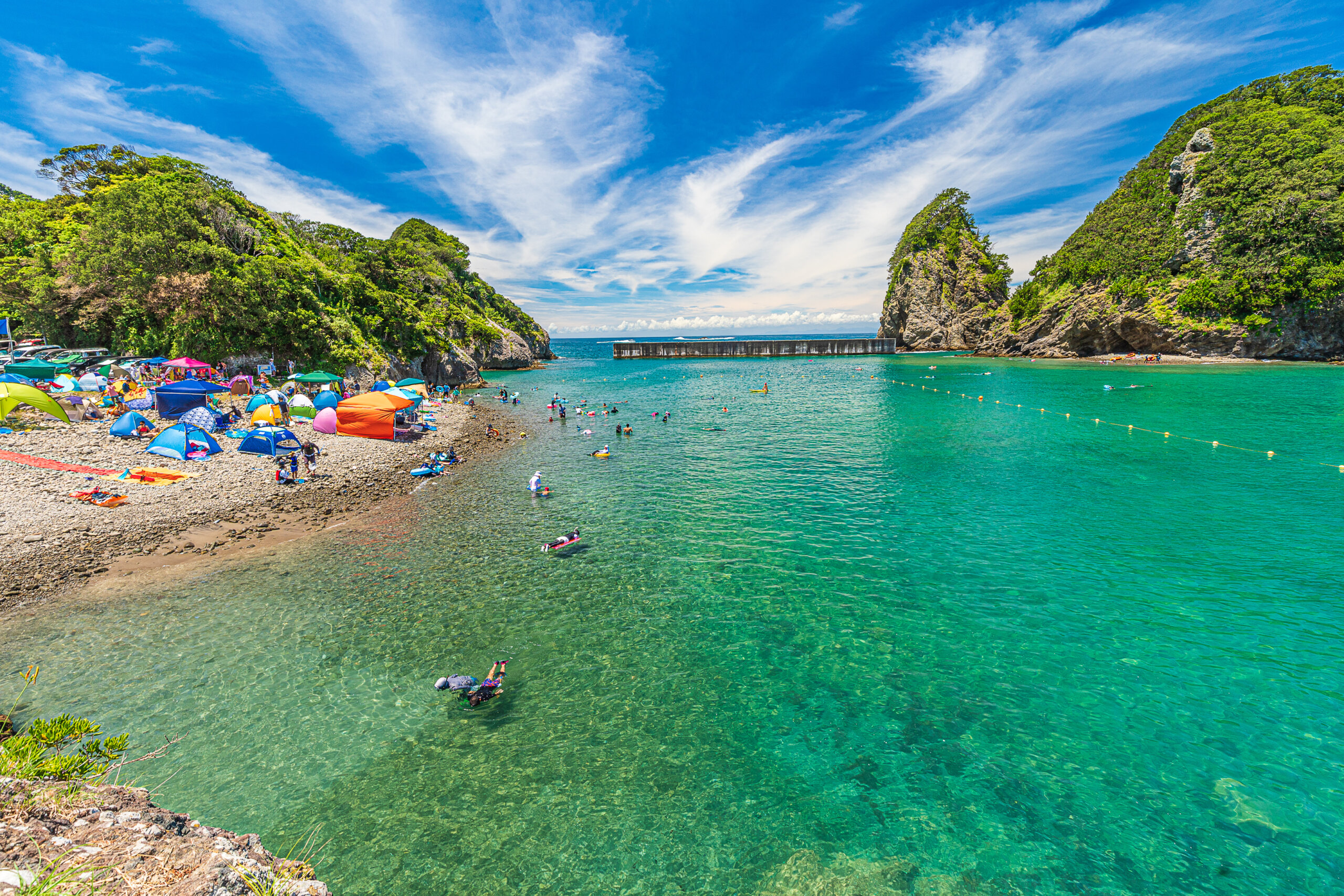
Dogashima is the place most likely to turn an abstract idea of “West Izu” into a specific image. The coastline is broken into islands, cliffs and caves, with bands of volcanic material visible in the rock. From the water, the coast feels sculpted. From land, it feels layered. At low tide, the geography changes again when the Tombolo can connect the shore to the Sanshiro Islands.
That is why Dogashima deserves more than a quick photo stop. It is a compact area, but several of its best experiences depend on different conditions: boats depend on the sea, the Tombolo depends on the tide, and the sunset depends on the sky. A little planning turns those variables into the strength of the visit.
Dogashima at a glance
| Experience | How much time | What to check |
|---|---|---|
| Tensodo cave excursion | About 20 minutes on the standard route | Same-day marine operating status |
| Land-based Dogashima views | 30–60 minutes | Weather and footwear |
| Tombolo / Sanshiro Islands | 30–90+ minutes depending on tide and how far you walk | Official tide level and return window |
| Sunset | 45–90 minutes | Sunset time, clouds and return transport |
| Onsen | 45 minutes to overnight | Opening hours or accommodation policy |
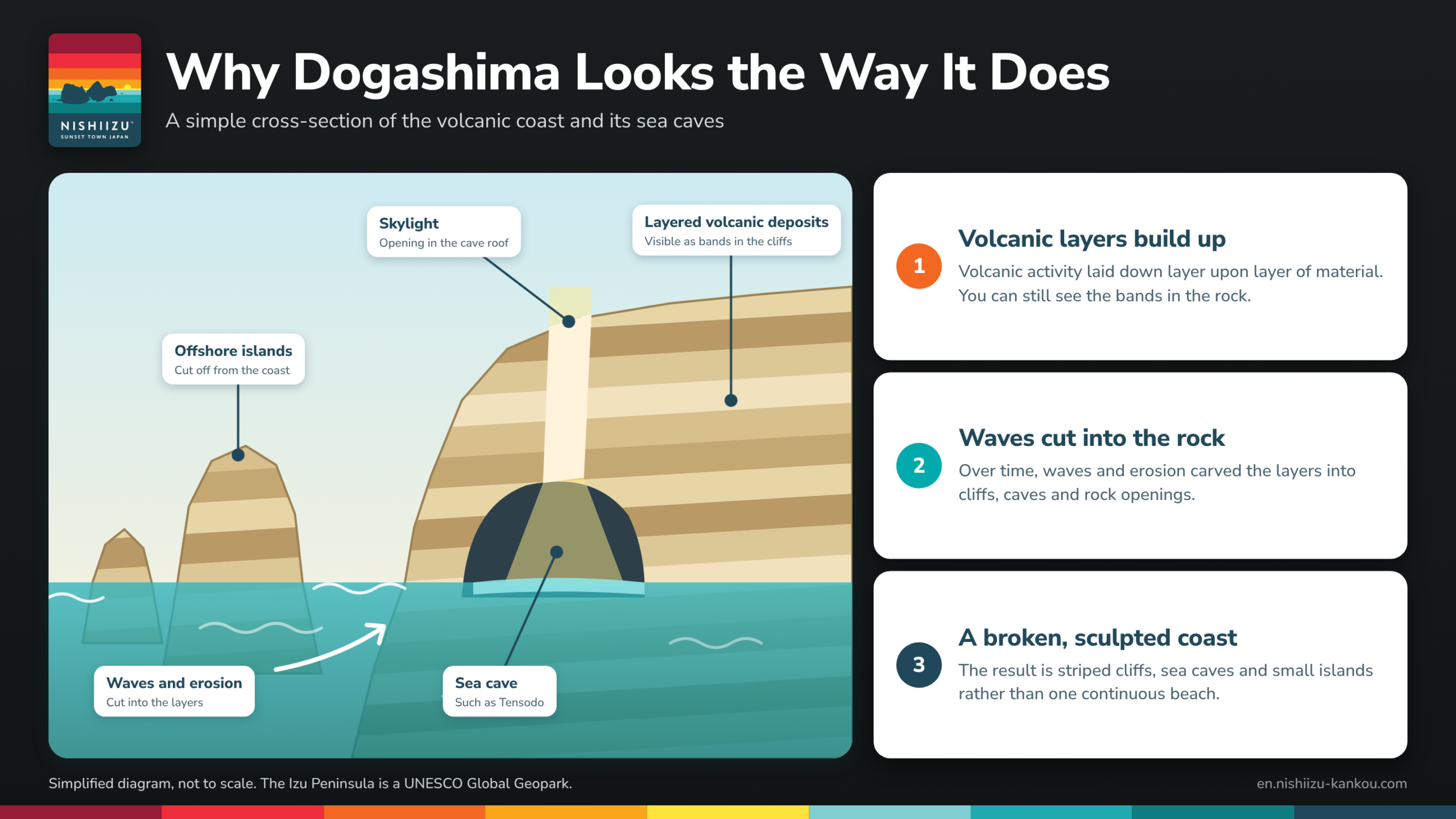
Why Dogashima looks the way it does
The Izu Peninsula is a UNESCO Global Geopark, and Dogashima makes the geology unusually easy to see. Volcanic activity created layers of material that were later cut by waves and erosion. The result is a coast of striped cliffs, caves, rock openings and small islands rather than one continuous beach.
You do not need a geology background to appreciate it. The main value of understanding the volcanic story is that the formations stop looking random. The cave, the cliffs and the offshore rocks become different parts of the same landscape.
Tensodo Cave and the Dogashima cave cruise
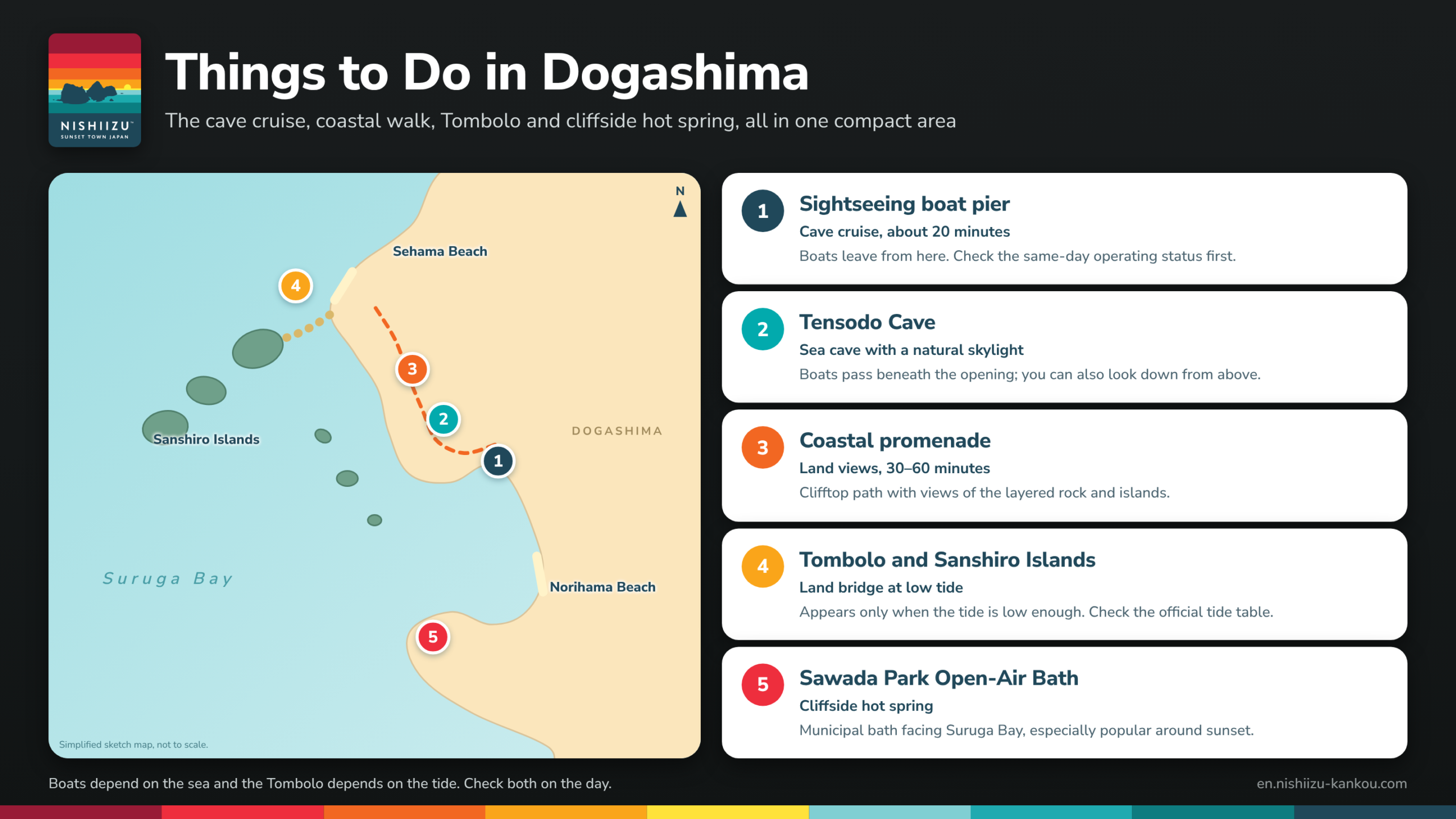
Tensodo is the best-known sea cave at Dogashima. The standard sightseeing boat enters the cave and passes beneath a natural opening in the ceiling, allowing daylight to fall onto the water. Dogashima Marine says Tensodo has three entrances and that the large south entrance extends about 147 meters; the cave was designated a natural monument in 1935.
As of August 2026, the standard cave excursion is listed at ¥1,500 for adults and ¥750 for elementary-school children, with a typical duration of about 20 minutes. Normal operating hours are listed around 10:00–16:00, with seasonal extensions — for example, summer 2026 uses 9:00–16:30. These are operational details, not evergreen facts, so the published article should keep a visible “check current operation” link.
The most important point is weather. Boats can be suspended when waves make the cave route unsafe. Dogashima Marine specifically advises checking the day’s status in the morning. If the cruise matters to you, do it before building the rest of the day around lunch or sunset.
The Tombolo to the Sanshiro Islands
Dogashima’s second defining experience happens on foot. At sufficiently low tide, a natural land bridge appears between the coast and the Sanshiro Islands. This is the Tombolo. JNTO describes the feature as one of Dogashima’s quick facts and warns visitors to check the tide schedule before crossing.
The Tombolo is not a permanent trail. That means the right question is not “What time does it open?” but “Will the tide be low enough, and how long is the safe window?” Use the official tide table and turn back early. Footwear with grip is preferable because the exposed route can be wet and uneven.
From an SEO/GEO perspective, this is also one of Nishiizu’s most ownable topics. The phenomenon is visually distinctive, easy to explain in a concise answer block and supported by first-party tide data — exactly the kind of information generative search systems can extract and cite.
What can you do if the boat is not running?
Stay. Dogashima is still worth visiting from land. Walk the coastal viewpoints, study the layered cliffs, check whether the Tombolo conditions are suitable, have lunch overlooking the sea, or move the onsen earlier. If you are driving, nearby beaches and Koganezaki also make strong weather-dependent alternatives.
How long should you spend at Dogashima?
Allow half a day if you mainly want the cave cruise and coastal views. Give it a full day if the Tombolo is important, if you want to wait for sunset, or if you prefer not to schedule the experience tightly around marine conditions.
| Visit style | Recommended time | Best approach |
|---|---|---|
| Quick stop | 1.5–2.5 hours | Cave cruise + land viewpoint |
| Half day | 3–5 hours | Cruise + walk + lunch + Tombolo if tide fits |
| Full day | 6+ hours | Add beach, sunset and onsen; best for slower travel |
Dogashima at sunset
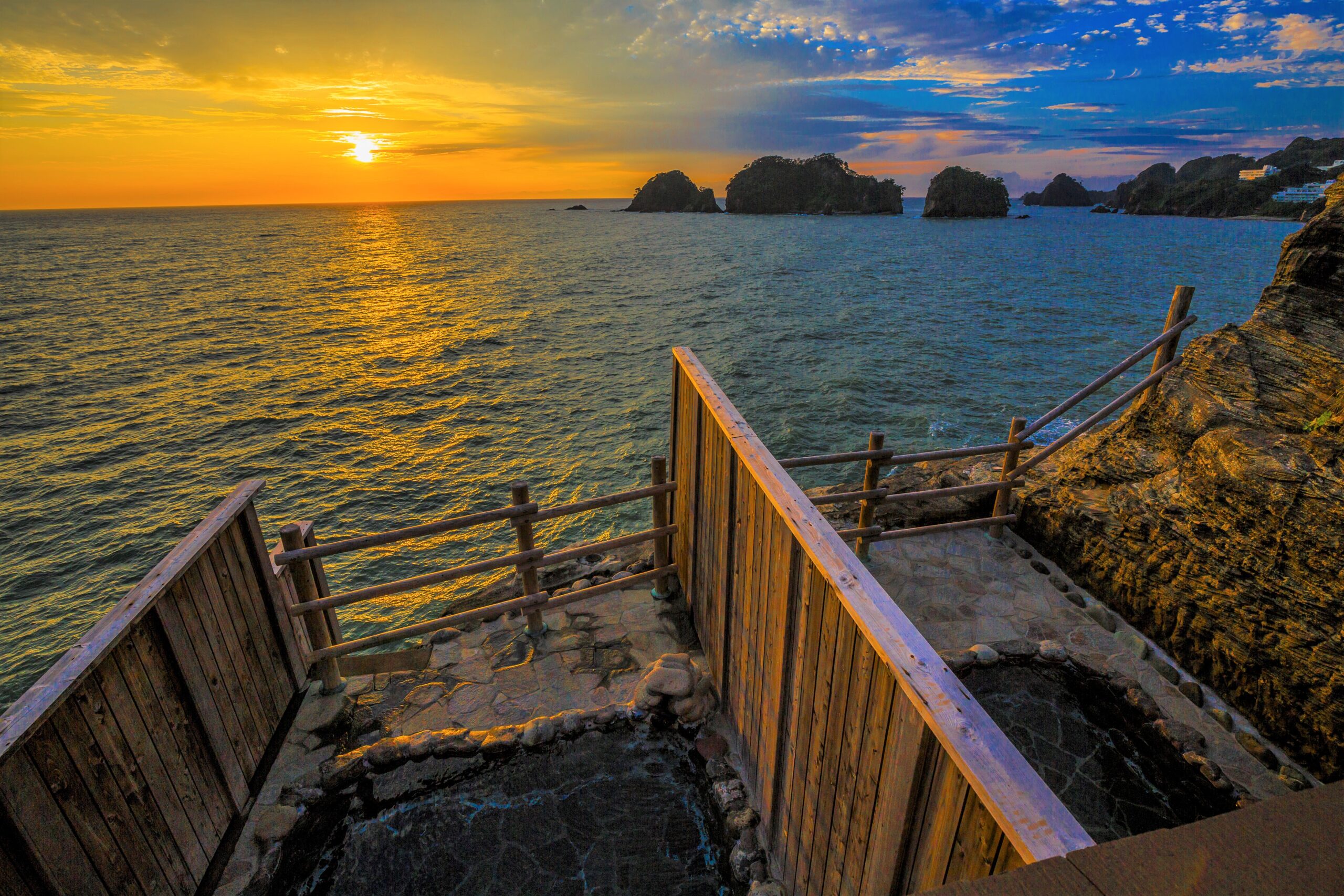
Dogashima belongs on any West Izu sunset list because the offshore islands and irregular rock formations create depth across the horizon. The scene changes quickly as the sun lowers: cliffs that look pale at midday become silhouettes, while the open water picks up warmer color.
If sunset is the final event of the day, arrive early enough to choose a safe viewpoint and stay through the afterglow. The strongest color often continues after the sun itself disappears.
Add an onsen after the coast
Dogashima is also one of the strongest places to combine scenery with a hot-spring stay. B-Izu highlights the area’s concentration of hot-spring hotels, many with sea views. Sawada Park Open-Air Bath, a municipal cliffside bath nearby, is specifically known for the ocean view and sunset setting.
This is one reason an overnight trip is stronger than a day trip: Dogashima can be both the active part of the afternoon and the view you are still looking at from the bath or room later.
How to get to Dogashima
JNTO lists Dogashima as accessible by bus, with approximately 90 minutes from Shuzenji Station and about 60 minutes from Izukyu-Shimoda Station. From Tokyo, the common West Izu approach is Shinkansen to Mishima, local rail to Shuzenji and then bus. Driving is easier for combining Dogashima with Koganezaki, Otago or multiple beaches.
Practical planning tips
- Check boat operation the morning of your visit.
- If the Tombolo matters, check the official tide table before you leave your accommodation.
- Do not schedule the cave cruise as the final possible activity before sunset; weather delays can remove your margin.
- Wear shoes with grip if you plan to explore the Tombolo or wet coastal areas.
- Keep a land-based backup plan for rough seas.
- If you are using buses, check the return time before committing to sunset.
Bottom line
Dogashima works because several forms of West Izu are compressed into one place: volcanic geology, a sea cave, a tide-controlled land bridge, marine activity, sunset and hot springs. Treat it as the anchor of the trip rather than another stop, and the rest of Nishiizu becomes easier to plan around it.