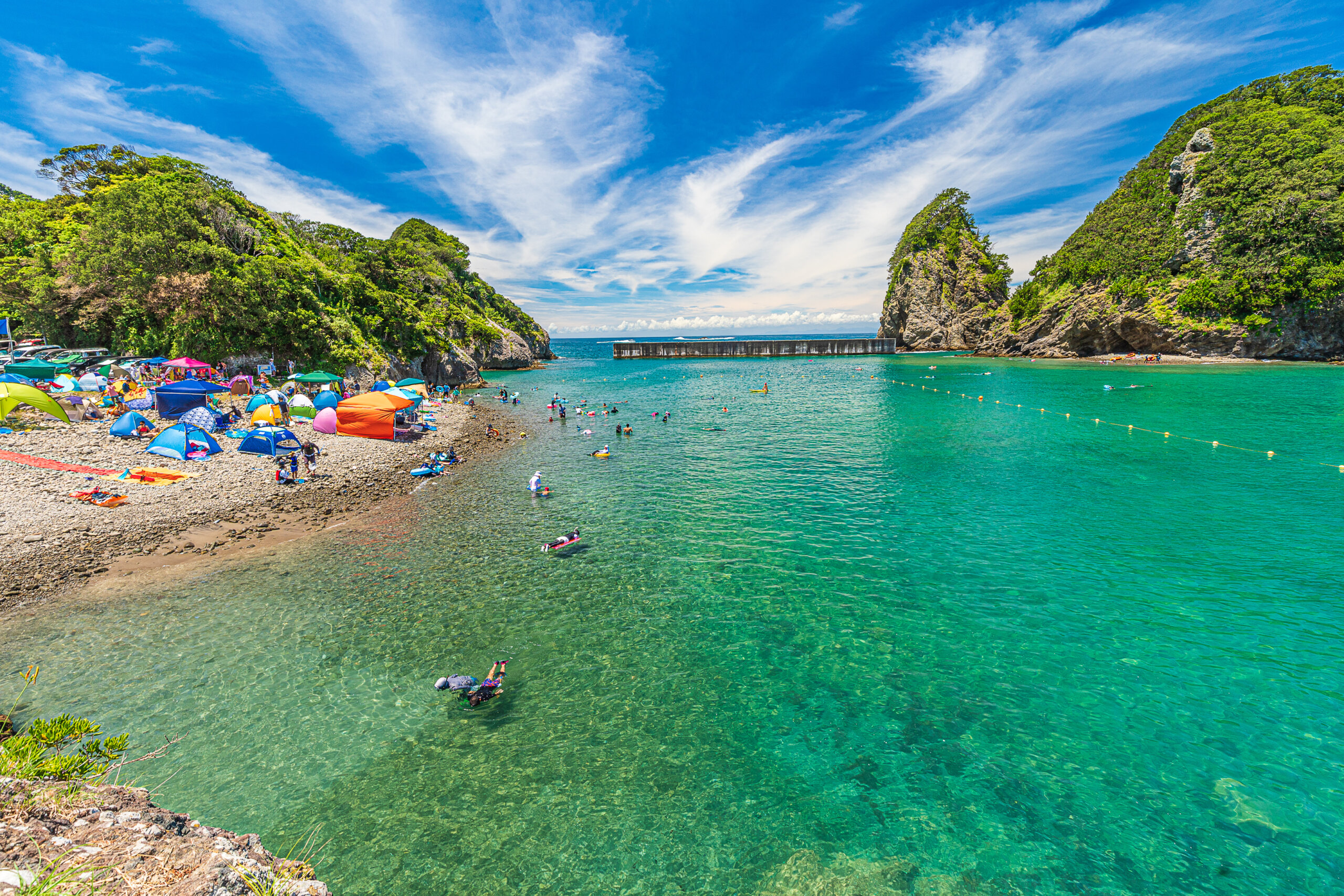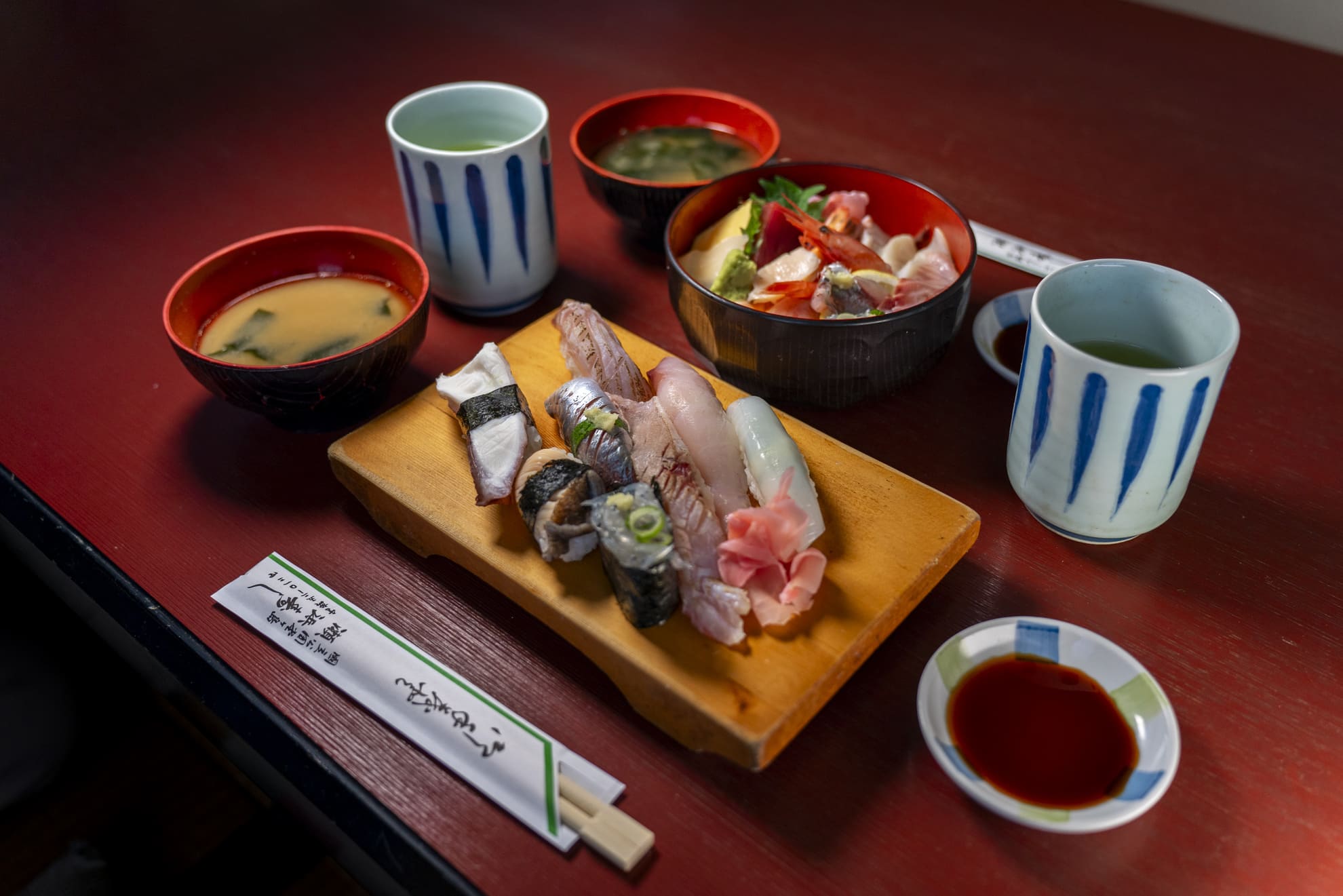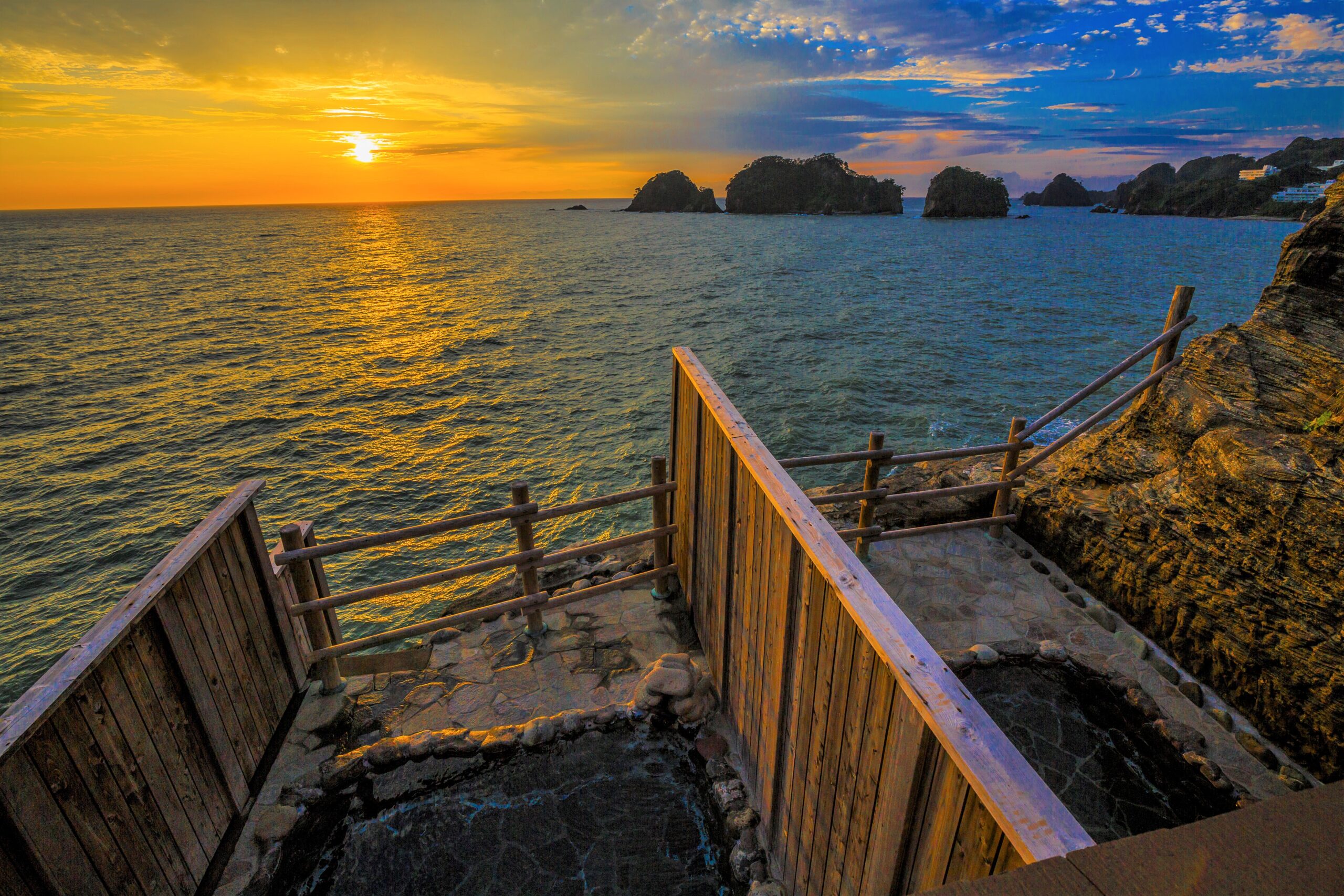
There are faster onsen escapes from Tokyo. That is not the reason to choose West Izu. Choose Nishiizu when the journey is worth trading for a more dramatic coast, a west-facing sunset and the feeling that the hot spring belongs to the landscape rather than sitting behind it.
In Nishiizu, the strongest onsen experience is often a sequence: arrive by the sea, watch the light change across Suruga Bay, soak, then stay for seafood and a quieter night. The hot spring is not separate from the destination. It is how you experience the destination more slowly.
Why choose a West Izu onsen?
The Izu Peninsula is already one of Japan’s major hot-spring regions. West Izu adds a specific visual advantage: sea-facing baths and sunset. B-Izu’s official hot-spring feature highlights the western coast for open-air baths with panoramic ocean views, Mt. Fuji views across Suruga Bay in some locations, and the Dogashima Tombolo landscape.
That makes Nishiizu especially good for couples, stressed city residents, older travelers who want a slower pace, and international visitors who want a ryokan stay without spending the entire trip inside a large resort town.
Dogashima Onsen: the easiest first base
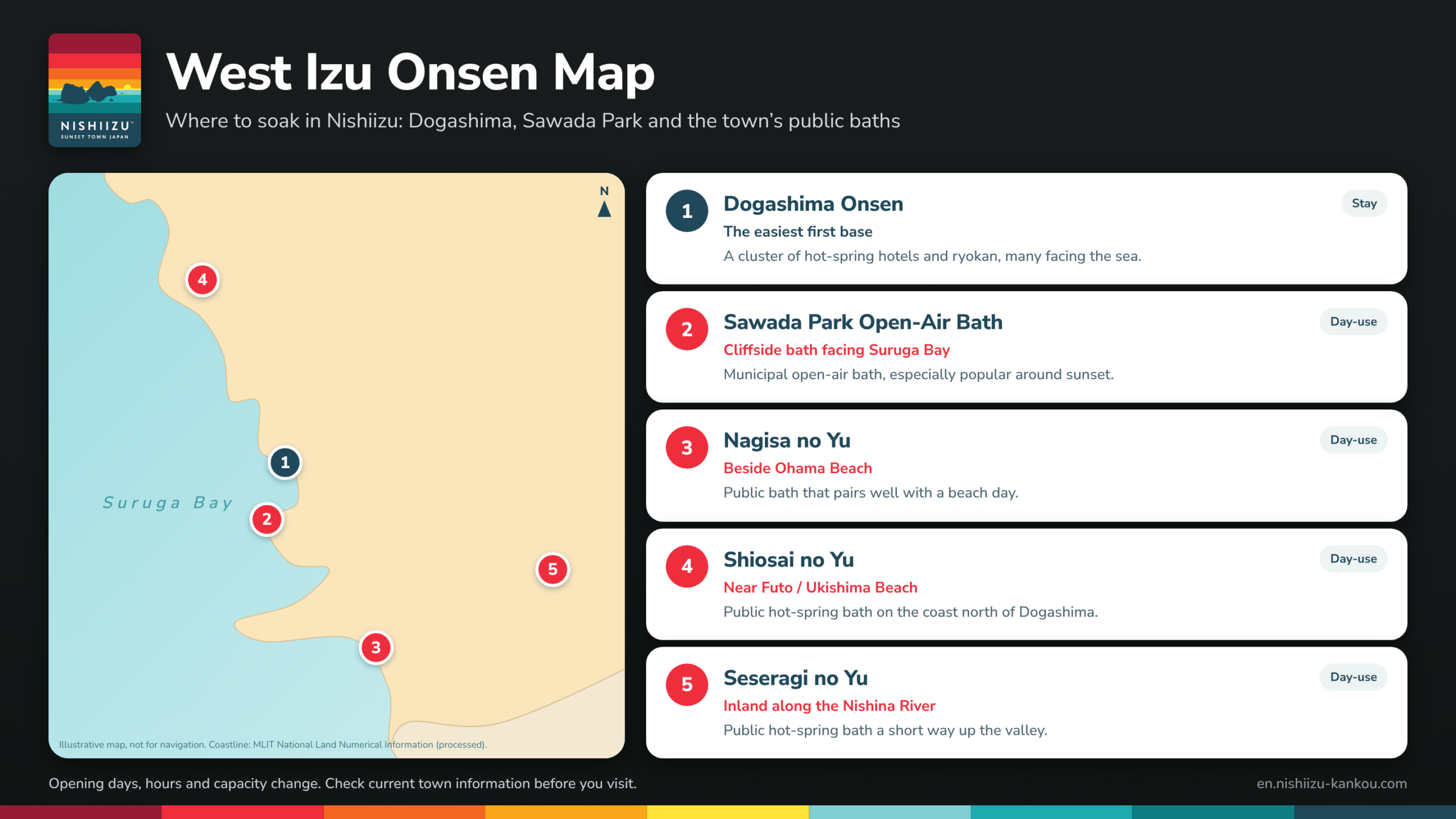
Dogashima is the most useful first-time base because the scenery and the accommodation experience overlap. You can spend the afternoon on the cave cruise or coastal walk, then check into a hot-spring property without leaving the area. B-Izu notes a concentration of hot-spring hotels around Dogashima, many oriented toward the sea.
When you compare properties, separate three questions: Does the room have an ocean view? Does the bath have an ocean view? Is there a private bath or an in-room open-air bath? Those are not the same feature, and the difference matters when sunset is part of the reason you are booking.
Sawada Park Open-Air Bath: the most direct sea-and-onsen experience
Sawada Park Open-Air Bath is a municipal day-use bath built on the cliff at Nishiizu. B-Izu describes it as a must-visit scenic open-air bath, and the town’s facility information confirms it as one of Nishiizu’s public hot-spring facilities. The core appeal is simple: separate outdoor baths face directly toward Suruga Bay.
It is especially attractive near sunset, but that popularity creates a practical issue. Capacity, opening hours and weather-related conditions can change. Treat it as a live facility and check the current town information before writing exact hours or before visiting.
Other public hot-spring options in Nishiizu
Nishiizu Town also lists Nagisa no Yu, Shiosai no Yu and Seseragi no Yu among its public hot-spring facilities, plus Yamabiko-so, a former school property known for using hot-spring water in its baths and pool. These give the content a useful second layer: you do not need a luxury ryokan booking to make onsen part of the trip.
Nagisa no Yu is particularly easy to pair with Ohama Beach, creating an active-to-restful progression that fits the Nishiizu positioning well.
How to choose a ryokan in Nishiizu
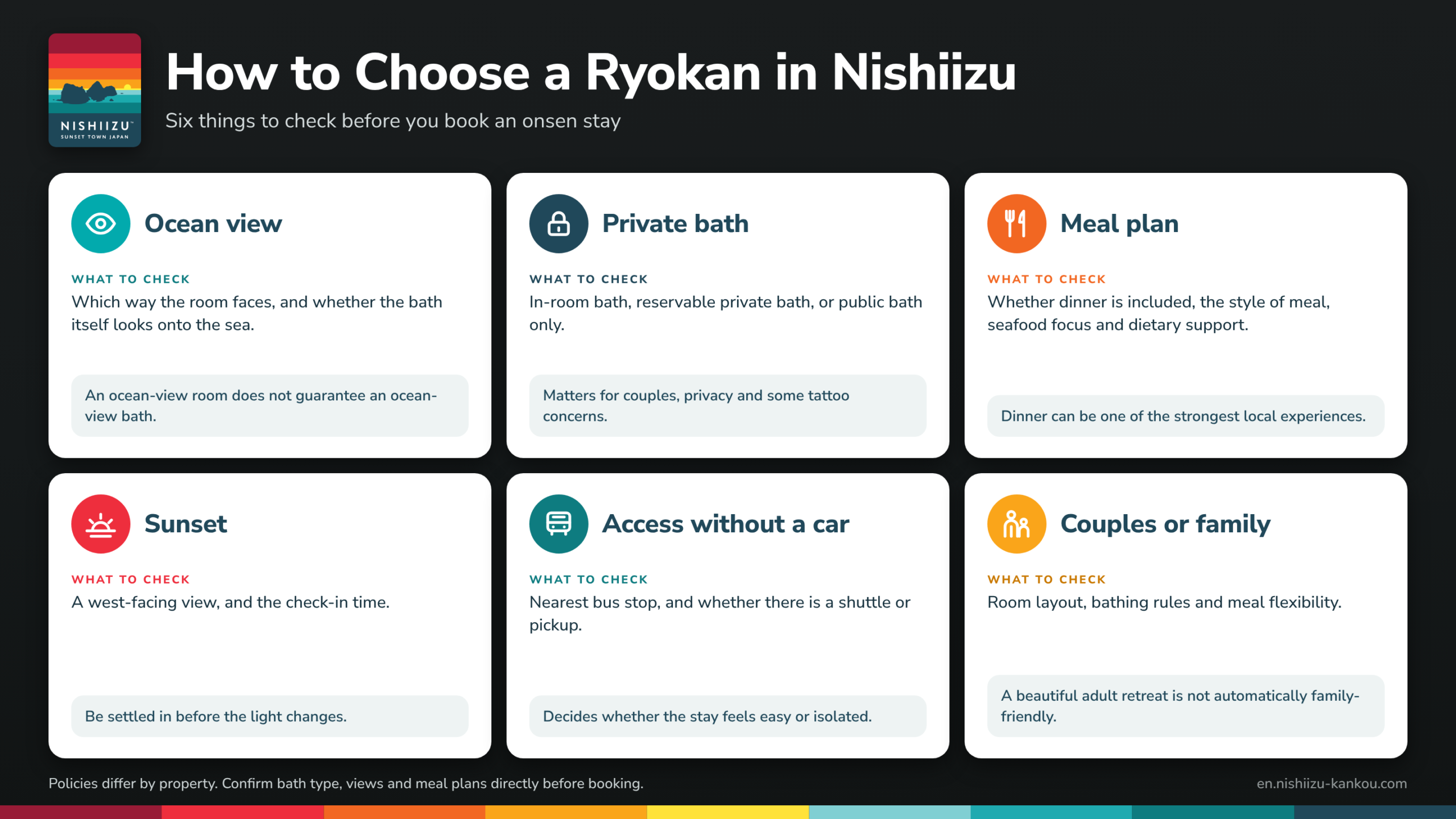
| Priority | What to verify before booking | Why it matters |
|---|---|---|
| Ocean view | Room orientation and whether the bath itself faces the sea | “Ocean-view room” does not guarantee an ocean-view bath |
| Private bathing | In-room bath vs reservable private bath vs public bath only | Important for couples, privacy and some tattoo concerns |
| Food | Dinner included, kaiseki style, seafood emphasis, dietary support | Dinner can be one of the strongest local experiences |
| Sunset | West-facing view and check-in time | You need to be settled before the light changes |
| No car | Bus stop, shuttle or pickup availability | Can determine whether the stay feels easy or isolated |
| Family | Room layout, bathing rules, meal flexibility | A beautiful adult retreat is not automatically family-friendly |
Private onsen vs. public bath
Private bathing can mean an open-air bath attached to the room, a bath that can be reserved for a time slot, or a family bath that guests use privately. Always read the property’s definition. If tattoos are a concern, a private bath may simplify the experience, but policies vary by property and should be confirmed directly.
For travelers who have never stayed in a ryokan, the large public bath is also part of the cultural experience. The decision is not only about privacy; it is about what kind of trip you want.
One night or two?
One night is enough to understand the appeal: Dogashima or a beach in the afternoon, sunset, bath, dinner, morning bath, breakfast, then one more coastal stop. Two nights is better if your actual goal is recovery rather than sightseeing. The second night removes the feeling that the onsen is a reward you have to earn after a packed day.
Best season for an onsen trip
Autumn through early spring is the easiest seasonal fit because cooler air makes outdoor bathing feel especially good, and winter can bring clearer views across the bay. Summer still works if you pair the onsen with swimming, kayaking or snorkeling, but the rhythm is different: water activity first, bath later.
How to get there from Tokyo
Public transport generally runs Tokyo–Mishima by Shinkansen, Mishima–Shuzenji by local rail, then Tokai Bus toward Nishiizu. Nishiizu Town lists the combined segments as roughly one hour, 30 minutes and 75 minutes before transfer time. Driving gives you more flexibility, especially if the ryokan is not directly on a major bus stop.
A low-stress onsen weekend
Day one: leave Tokyo in the morning, have lunch in Nishiizu, spend only two or three hours sightseeing, then check in early. Watch sunset, soak and eat. Day two: take a morning bath, have breakfast, choose one coastal walk, beach, food or craft stop, then return. The restraint is intentional.
Bottom line
West Izu onsen is not the best answer when your only metric is fastest travel time from Tokyo. It becomes the better answer when you want the coast, sunset, seafood and hot spring to feel like one experience. Nishiizu earns the extra distance by giving you something to look at while you slow down.